How to Build Winning Consumer Finance Applications in the Age of AI
Building winning consumer finance applications isn't just about adding AI. It's about creating experiences that help people feel informed, confident, and supported.


Written by Sarah James ·
Meet TomoIQ
Your AI-powered credit assistant.
A few months ago, asking ChatGPT for financial advice might have sounded odd. Today, it's becoming the norm.
People are asking AI whether they should pay off debt or invest. They're using it to create budgets, understand credit scores, compare financial products, and make sense of complex financial decisions.
In a recent Fast Company article, I explored why people increasingly trust AI with financial questions. What struck me most wasn't the technology itself. It was what this shift says about the relationship consumers have with money.
People aren't necessarily looking for more financial products. They're looking for guidance.
A few months ago, asking ChatGPT for financial advice might have sounded…odd.
Today, it’s becoming the norm.
People are asking AI whether they should pay off debt or invest. They’re using it to create budgets, understand credit scores, compare financial products, and make sense of complex financial decisions.
In a recent Fast Company article, I explored why people increasingly trust AI with financial questions. What struck me most wasn’t the technology itself. It was what this shift says about the relationship consumers have with money.
People aren’t necessarily looking for more financial products.
They’re looking for guidance.
For many people, money feels intimidating.
Financial terms can be confusing. Credit scores often feel mysterious. And despite having more financial tools available than ever before, many consumers still feel like they’re navigating their financial lives alone. And trust me, I know from firsthand experience as an immigrant navigating the American credit system.
AI changes that dynamic.
Instead of spending hours searching through articles or waiting to speak with a financial professional, consumers can ask a question and receive an answer instantly.
Questions like:
These aren’t uncommon questions. They’re everyday financial decisions that millions of people face.
The difference is that AI makes it easier to ask them.
Many people assume consumers trust AI because it’s smart. I think the answer is more human than that. People trust AI because it feels accessible.
There’s no judgment.
No embarrassment.
No fear of asking a question that feels too basic.
Consumers can ask the same question three different ways until they understand the answer. They can explore financial concepts at their own pace. They can admit what they don’t know.
For many people, that’s a more comfortable experience than traditional financial education.
The rise of AI isn’t just a technology story.
It’s a consumer behavior story.
For years, financial institutions focused primarily on providing products. Consumers, meanwhile, were looking for education, guidance, and personalized recommendations.
The popularity of AI highlights a growing expectation: people want financial information that is personalized, immediate, and easy to understand.
The companies that succeed in the next decade won’t simply offer financial products.
They’ll help consumers make better financial decisions.
That doesn’t mean AI should replace human expertise.
AI can provide information, explain concepts, and help consumers understand their options.
But context still matters.
Financial decisions are personal. Two people with the same income can have completely different goals, obligations, and risk tolerances.
That’s why the future of financial guidance isn’t AI versus humans.
It’s AI and humans working together.
At TomoCredit, we’ve seen firsthand how much consumers want personalized financial guidance.
The challenge isn’t access to information. The internet already has more financial content than anyone could ever consume.
The challenge is relevance.
Consumers don’t want generic advice. They want guidance that reflects their actual financial situation, goals, and behavior.
That’s where AI has the potential to create meaningful change.
Not by replacing financial expertise, but by helping people understand their options, build confidence, and take action.
The growing trust in AI for financial questions isn’t really about technology.
It’s about people searching for a better way to navigate their financial lives.
And that’s a trend that isn’t going away anytime soon.
For a deeper dive into this topic, you can read my Fast Company article, “Why People Trust AI With Financial Questions.”
Building winning consumer finance applications isn't just about adding AI. It's about creating experiences that help people feel informed, confident, and supported.
From immigrating to the United States at age 11 to building TomoCredit, Kristy Kim reflects on the curiosity, adaptability, and trust that shaped her entrepreneurial journey.
ChatGPT gave surprisingly solid advice on how to build credit — but the more I read its answer, the more I realized it was giving information, not guidance.
The language used on this page is for creative purposes only. TomoCredit (or TomoBoost) does not guarantee an increase in credit score. Individual results vary based on each person's unique credit history and financial circumstances, and subscription payments are non-refundable.
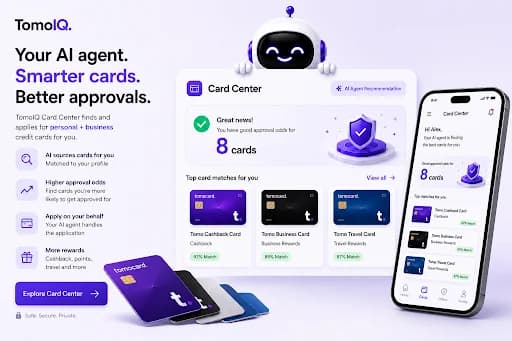
Meet TomoIQ
Your AI-powered credit assistant.