
5 Life Essentials That Are Surprisingly Easy to Save Money On
Rising living costs don't mean you have to overhaul your life. These five everyday categories are where small, sustainable changes add up the fastest.


Written by Sarah James ·
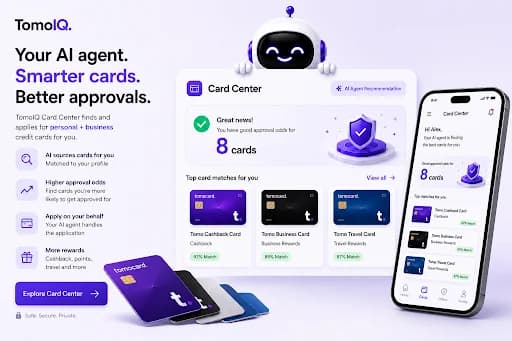
Meet TomoIQ
Your AI-powered credit assistant.
You were going to cancel that subscription. You were going to check whether your savings account pays a decent interest rate. You were going to figure out why your phone bill went up. Then you had a meeting. Your kid needed something. You had groceries to buy, dinner to make, and approximately fourteen other things that felt more urgent. Now another month has passed.
A new Wall Street Journal article looks at whether AI could help consumers address costly financial oversights, including forgotten bills and cash sitting in accounts that earn little interest. That raises a question: How much easier could managing money become if getting started didn't feel like another job?
Personal finance advice often assumes you have plenty of time and attention. Compare every account. Read every statement. Track every expense. Review your budget regularly. Stay informed. All reasonable suggestions. But when, exactly?
Everyone is already overtired, overworked, overextended. People have careers, families, unpredictable expenses, and lives that don't pause for a monthly financial review. A money plan that requires you to be perfectly organized every day is going to be difficult to maintain. It has to work on a Tuesday when you're tired, your schedule is full, and you have ten minutes.
This is where financial AI can be a huge help. It can give you somewhere to start. Somewhere to ask the question you don't know how to phrase. Somewhere to turn a confusing bill or a vague money goal into a manageable next step. TomoIQ is designed to do exactly that.
"Fix my finances" is a lot to ask of anyone, including yourself. Try something more specific:
Specific questions make it easier to get an answer you can actually use. They also make it easier to check that answer against your real circumstances. You might discover that the task you've been avoiding doesn't require an entire weekend. It requires finding one statement, checking one charge, or making one phone call. That is progress.
Pick one of these. You do not need to do all three today.
Choose the task that would give you the most relief. Finish it before adding another.
There is a growing conversation about AI that can take financial actions on your behalf. Consumers should be able to understand what a tool is recommending and control what happens next.
What information is it using? Are the rates and terms current? Does it understand the bills you have coming up? An answer that sounds confident still needs to hold up when you check it. You can use AI to explain unfamiliar terms, organize information you choose to share, or prepare questions for your bank. Before moving money, opening an account, or changing a payment, verify the details. Getting help should make a decision clearer.
Financial support should meet people where they are. You shouldn't have to arrive with perfect financial knowledge or an expertly organized spreadsheet before you can ask for help. You should be able to say, "Here's what's going on. Help me understand my next step."
For some people, that step will be paying down debt. For others, it will be understanding a bill, preparing for an upcoming expense, or finally looking at an account they've avoided. Those may sound like small wins. But a finished task gives you something an ambitious, untouched plan can't: a place to move forward from.
What's the money task you keep putting off? Start there.
Rising living costs don't mean you have to overhaul your life. These five everyday categories are where small, sustainable changes add up the fastest.

Most passive income advice assumes you're starting with real estate money or a stock portfolio. Here's how to start with $10, $25, or $50 at a time instead.
ChatGPT gave surprisingly solid advice on how to build credit — but the more I read its answer, the more I realized it was giving information, not guidance.
The language used on this page is for creative purposes only. TomoCredit (or TomoBoost) does not guarantee an increase in credit score. Individual results vary based on each person's unique credit history and financial circumstances, and subscription payments are non-refundable.
See full article: https://tomocredit.substack.com/p/tomocredit-youre-busy-your-money
Meet TomoIQ
Your AI-powered credit assistant.